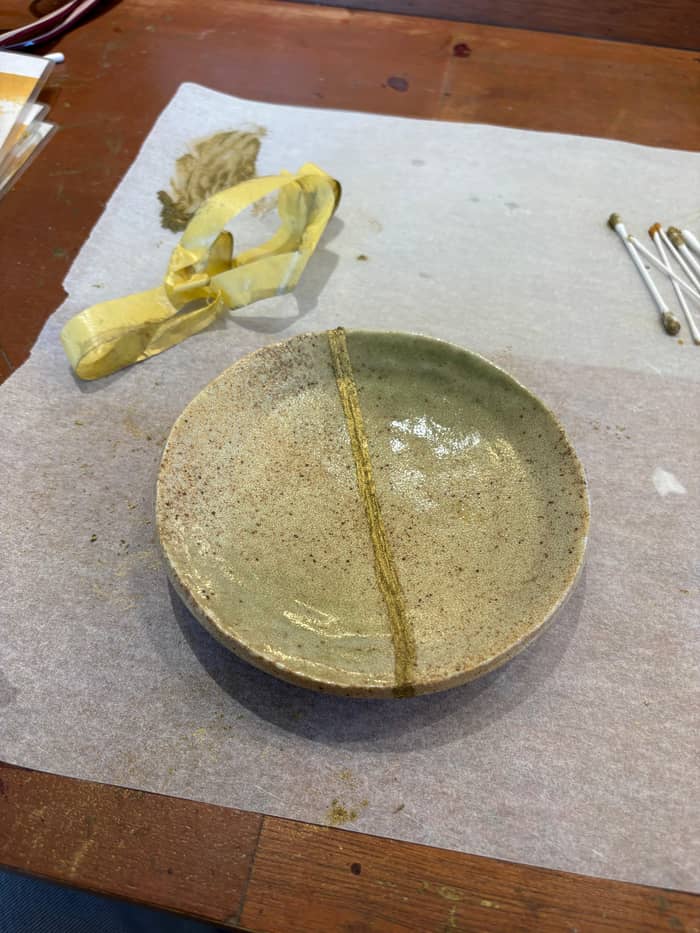
The one on this page
Real urushi, 1 hour
Our Asakusa class
- MaterialUrushi and gold
- Time1 hour
- Pricefrom $15
Quick decision aid
Kintsugi workshop in Asakusa
★ 4.9 · 1,300 written reviews
Fast answer
A modern kintsugi workshop uses epoxy and a brass-colored finish, while the traditional method uses urushi lacquer and real gold powder.
Method essentials
Two questions, one pick
Say what you want to do with the piece and who is coming, and a class appears with its starting price.
Suited to you
from $15
The listing says real urushi lacquer and gold powder in 1 hour.
Suited to you
from $58
The listing says synthetic lacquer and substitute gold powder.
Suited to you
from $44
It runs 1.5 hours for up to 6 participants.
Two very different afternoons share one name. One uses natural lacquer that must cure, the other uses resin that sets the same day. Here is what changes for your hands, your piece and your wallet.
Editorial team, kintsugitokyo.com · Updated November 6, 2026 · Takes 6 min
Basics
People searching for a modern kintsugi workshop usually find two different things under one word. The first is the repair method that Japan has refined for centuries, in which broken ceramics are joined with a lacquer-based adhesive and the seams are decorated with gold, silver or platinum.8 The second is a craft class that borrows the look, using resin and a gold-colored powder so that anyone can finish a piece in an hour.
Japanese sources already have words for the second kind. Japan Up Close says a new technique called simple kintsugi has emerged in recent years, simplifying the process through the introduction of technology.9 The Japan Creative Centre in Singapore describes it as using water-resistant craft glue and acrylic ceramic paint instead of lacquer.10 A Tokyo studio calls its epoxy class kintsugi-style and notes that the brass-colored result is often called modern kintsugi.2
None of this makes the modern kind fake in the sense of a scam. It is a different activity, sold as a craft experience, and a good class will tell you which one it is. The trouble starts only when a listing says kintsugi and leaves the materials unsaid, so you arrive expecting an heirloom repair and leave with a bright key chain.
The two methods
| What you compare | Traditional | Modern |
|---|---|---|
| Binder | Urushi and rice glue | Epoxy resin |
| Finish | 23K gold powder | Brass-colored powder |
| Session at one studio | 90 mins | 60 mins |
| Price at one studio | 22,000 JPY | 6,600 JPY |
| Finished when | After weeks of curing | Same day |
| Skin | Urushi can irritate | Suits sensitive skin |
| Food use | The tableware repair | Accessories only |
Cells follow the Tsugu Tsugu comparison page and the sources on this page; other studios may differ.18,3,2,7,19,1
A traditional kintsugi workshop rests on urushi, a lacquer made from the sap of a tree. JNTO notes that cracks are traditionally bound using urushi lacquer, and that one 20-year-old tree can produce only about a cup of lacquer before it is cut down.14,15 In the old process urushi served as the binder with rice glue to join the ceramic fragments.1
The Embassy of Japan in Singapore adds that kintsugi was perfected in the Edo period using only natural materials for the lacquer, such as rice powder and mountain soil.16 Once the pieces are glued, gold powder is dusted or dabbed along the cracks and clings to the glue that has seeped out.12 That last step is what a short class lets you do, and it is the most photogenic one.
Gold is the other variable. One Tokyo studio says its traditional finish uses 23K gold powder and that a brass finish is not certified as food safe.3 LACMA conservators noted that brass powder costs far less than gold powder, which is why they used brass for a practice exercise.17 In a class, that price gap is one reason the powder is applied in tiny amounts.
Time at the bench
Session lengths come from our Viator record and from the comparison table of the Tsugu Tsugu studio; a short session does not mean a finished urushi repair.18
The modern class trades the long chemistry for a short one. The studio workshop we found uses epoxy and a brass-colored finish, creates decorative joints, and lasts 60 minutes for ages 6 and over.2,5 You can make small items such as chopstick rests, earrings or key chains from pottery pieces or sea glass, and make as many as the time allows.
LACMA conservators describe a quick middle path. For a practice exercise they filled losses with a two-part epoxy putty, then covered the join lines with urushi and applied brass powder, skipping the traditional urushi and rice glue binder.22,1,17 So even museum staff treat the full method as a specialist craft and use shortcuts to teach it.
The same museum says that for most objects in its collection, kintsugi would not be an appropriate method of repair, and that its conservators are not kintsugi masters.23 That is a useful reminder: the repair is valued as an art and a tradition, not as the safest way to restore a vessel for daily use.
Three listings
The one on this page
Our Asakusa class
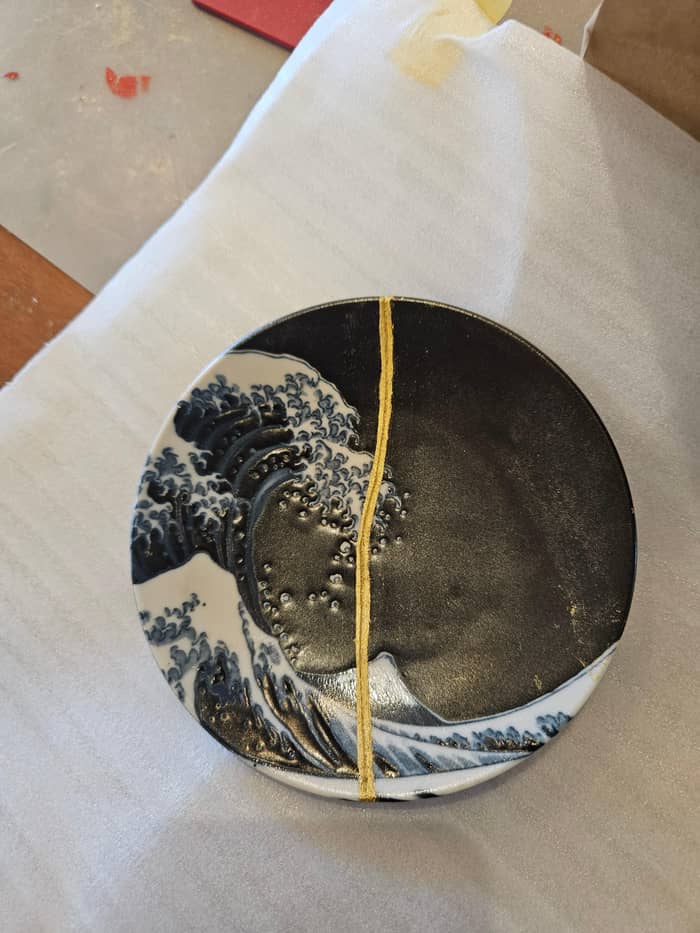
Substitute gold
Resin atelier class
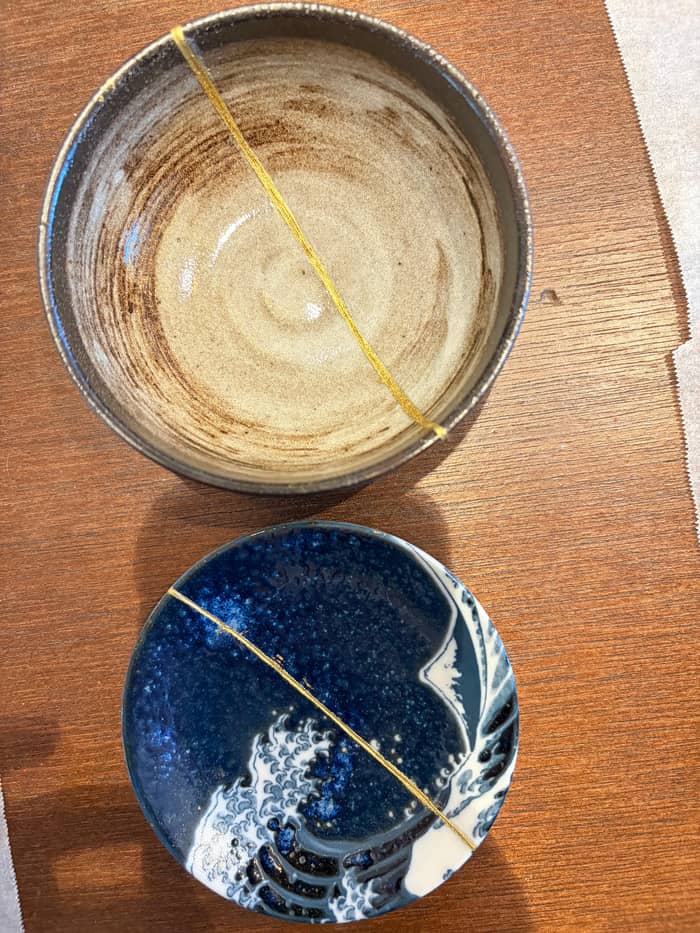
More time
The longer Asakusa class
Time is the biggest practical difference. Urushi hardens as it takes in moisture, which is why makers leave it to dry in a room with controlled humidity and temperature.24 One Tokyo studio says drying takes several days to a week or more, and tells guests to keep a take-home piece in a closed box in a warm place around 20 to 30 degrees Celsius for at least one day.6,13
That is why a one-session class cannot finish a traditional repair from scratch. A Tokyo studio says a complete repair takes days to weeks, often longer, so its 90-minute workshop gives you a vessel that is partly prepared in advance and lets you do one intermediate step and the final gold dusting.4 Its regular classes say a full repair usually takes two to three months and around 10 classes.20
Repair customers wait even longer. At the Asakusa studio of the same operator, traditional repairs usually take at least three to four months and must be collected in person.25 A modern class needs none of this patience, and for a traveler with a flight to catch that is a fair reason to choose it. If you pick the traditional route, ask how the studio handles drying and shipping.
Price your group
Type your party size and see each class total.
Compare 4 side by side
Type your party size and see each class total.
≈
View≈
View≈
View≈
ViewFigures are GetYourGuide from-prices, translated at the ECB reference rate. The booking step shows what you pay exactly.
The traditional repair
Join
Urushi acts as the binder with rice glue to join the fragments.1
Set
LACMA sets the urushi a little in a sealed box with a damp towel.11
Dust
Gold is sprinkled or dabbed on the cracks and clings to the glue.12
Cure
A complete repair takes days to weeks, often longer.4
Home
A studio drying box stays closed in a warm place for at least one day.13
Lacquer is not a neutral material. LACMA says urushi is made from the sap of the urushi tree and is actually toxic,26 and one studio puts it as a rash similar to poison ivy from touching raw urushi.6
That is why instructors guide the work closely, and why a studio recommends its epoxy workshop to guests who are sensitive to urushi, since no urushi is used in it.7 If you have ever reacted to a plant or a lacquered bowl, tell the studio before you book and ask which class fits you. A good studio would rather move you to a resin session than send you home with an itchy wrist, and a decent listing says up front which material it uses.
Food is the second question. The epoxy workshop is designed for small items and accessories and is not intended for repairing tableware for food use, while the studio notes that a brass finish is not certified as food safe.19,3 A traditional piece with real gold is the one made to be used at the table, though how long its lacquer needs to cure is worth asking about before the first meal.
Video
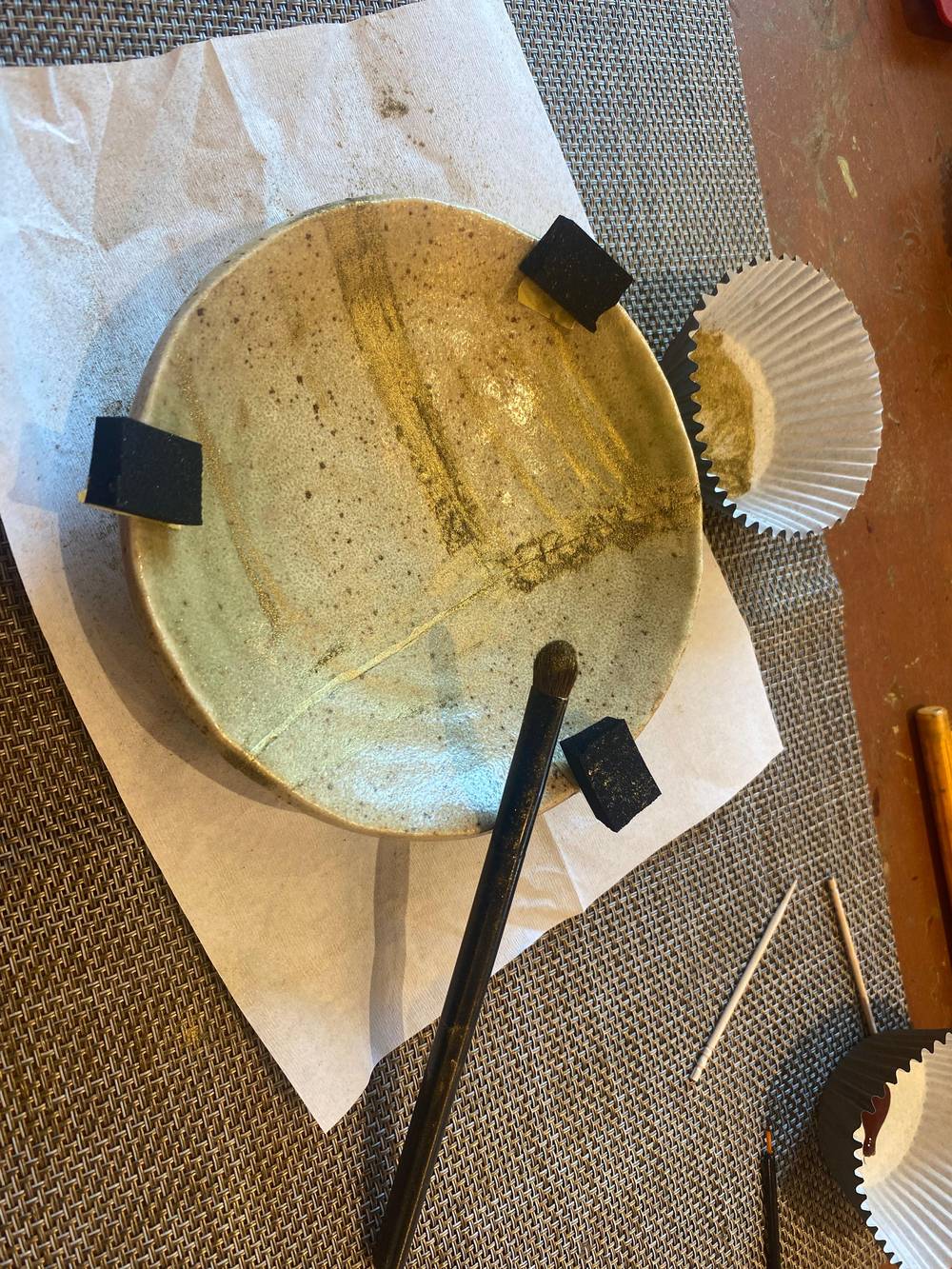
Lakeside Pottery Studio on YouTube · Video data is requested only when you tap play.
In the traditional kintsugi process, the urushi would be used as the binder with rice glue to adhere the ceramic fragments together
Checklist
Price does not tell you the method. At one Tokyo studio the traditional workshop costs 22,000 JPY a person and the kintsugi-style workshop 6,600 JPY.18 Yet on the booking platforms the opposite can happen: our Asakusa listing, which says real urushi lacquer and gold powder, starts from $15, while a listing that says synthetic lacquer and substitute gold powder starts from $58.
The explanation is plain business: group size, rent and what the operator includes differ. A big shared room like ours spreads the cost, while a small kintsugi art workshop in an atelier, with a handcrafted vessel by a named potter, charges for the object and the attention. Read the listing, not the price tag, to see which material you will touch.
If you want to continue at home, kits exist for both worlds. The Tsugu Tsugu range runs from a starter kit with 0.1 g of 23kt gold powder to a gold-only kit with 0.5 g of it, all labelled genuine urushi.27,28,29 The studio says that with its materials drying takes several days to a week or more, which is another reason to buy a kit only when you can wait.6
FAQ
Its pieces are meant as accessories, not for repairing tableware for food use.19
The listing says real urushi lacquer and gold powder, and the class lasts 1 hour.
A traditional listing starts from $15, a synthetic-lacquer one from $58.
Sources
Continue reading
Questions about the session? Someone on the team answers right here.