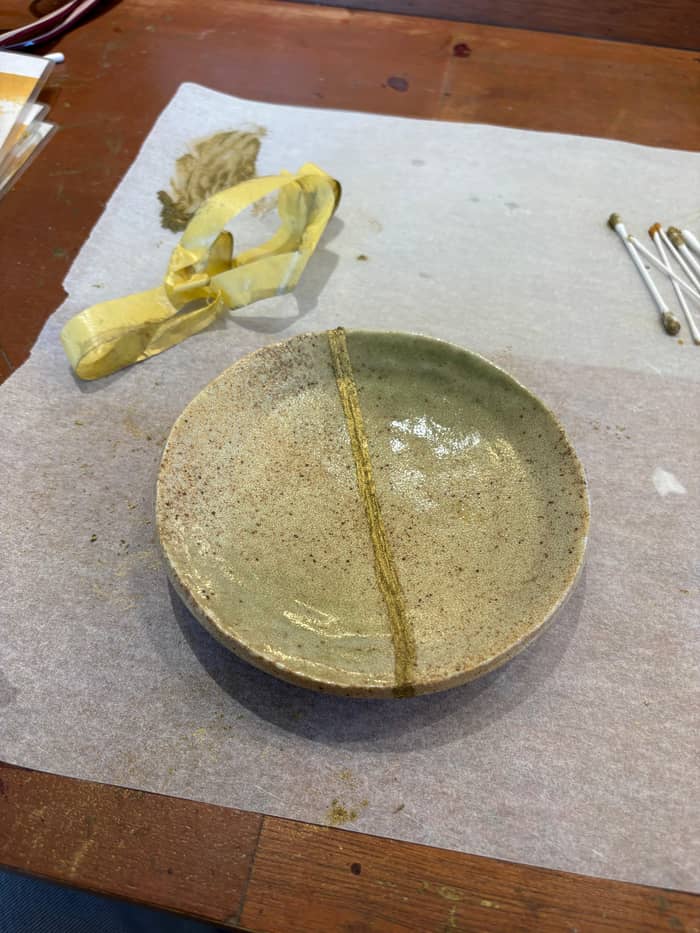
Late 15th century
The legend
The shogun and the clamp
- Sourcee-Museum and Japan Up Close
- MendMetal clamp
- StatusA theory
Group price calculator
Fast answer
The Japanese art of fixing broken things, kintsugi, grew out of ancient lacquer repair and came into use in the Muromachi period, from 1336 to 1568.
History essentials
Compare 3 side by side
Type your party size and see each class total.
≈
View≈
View≈
ViewFigures are GetYourGuide from-prices, translated at the ECB reference rate. The booking step shows what you pay exactly.
Kintsugi did not appear in a single moment. It grew from ancient lacquer repair, a famous legend and the tea rooms of the Muromachi era. Here is the story as the sources tell it, and where they disagree.
Editorial team, kintsugitokyo.com · Updated November 6, 2026 · Takes 6 min
Basics
The Japanese art of fixing broken things is older than its famous name. Japan Up Close says the habit of fixing and gluing vessels with lacquer, similar to kintsugi, has been around since the Jomon period, and that this tradition was also common in China.1 People in the past realised that the sap that oozes from lacquer trees acts as an adhesive, so a cracked pot did not have to be thrown away.
How old is lacquer itself? The sources give different figures. JNTO counts 9,000 years of use of the natural lacquer urushi in Japan, while Web Japan says urushi has been used as a coating and adhesive for more than 7,000 years.6,7 The gap likely reflects what each writer counts as use, and neither claims to date a particular repair. Both agree the material is ancient and that mending was one of its jobs.
Notice what is missing from this early picture. Nothing in it says the repair was meant to be seen. A lacquer seam on a plain cup was practical, a sign of thrift, and the gold that gives kintsugi its name came later, once a certain kind of host decided that a mended bowl could be worth more than an unbroken one.
Period by period
| Era | What the sources say | Who says it |
|---|---|---|
| Jomon | Lacquer mends vessels | Japan Up Close |
| Muromachi | Kintsugi starts with tea culture | Japan Up Close |
| Late 15th century | The clamped bowl legend | e-Museum |
| 16th century | Mending pots was popular | LACMA |
| Edo period | Natural materials, tea items only | Embassy of Japan |
| 2000s | A beginner guide reaches the public | Embassy of Japan |
| 2011 | New interest after the earthquake | Japan Up Close |
| March 2024 | Added to the Oxford dictionary | Nippon.com |
Each row restates one source; where two sources overlap, the earlier one on this page is cited.1,2,9,15,16,4,17,5
The most repeated origin story belongs to a shogun. Japan Up Close puts it this way: one theory of the origin of kintsugi is that it emerged when Ashikaga Yoshimasa sent a damaged Chinese tea bowl back to China for repair in the late 15th century, and that it came back with metal staples that were not beautiful.3 Japanese craftsmen, the theory goes, then looked for a more aesthetic way to mend.
The bowl is not a myth, and you can read its record. The e-Museum database of the National Institutes for Cultural Heritage says Yoshimasa cracked the bowl on the bottom and sent it to China for an exchange, and that it came back with the crack fastened by a clamp.9 The large clamp looked like a locust, so the bowl was named Bakohan, meaning large-locust clamp.10 The account comes from a record written in 1727 by the Confucian scholar Ito Togai.11
Read the dates and the caution carefully. The record was written centuries after the events, and the bowl was mended with a clamp, not with gold lacquer. JNTO phrases the link with care, saying only that some historical sources suggest kintsugi was introduced as a more aesthetically pleasing solution for mending valuable ceramics.12 The legend is a handy hook, not a documented invention.
Quoted ages
The firmer link is to tea. Japan Up Close writes that kintsugi started to be used in the Muromachi period, from 1336 to 1568, when tea ceremony culture flourished, and that people who admired the technique called it keshiki, meaning scenery.2 The Embassy of Japan in Singapore agrees that the origin of kintsugi is deeply intertwined with the tea ceremony, and puts its history at over 500 years.14
JNTO opens its own account with the same span, noting that for more than 500 years pottery in Japan has found new life through kintsugi, the art of sealing cracks with lacquer and gold powder.13 That span is why the Japanese art of fixing broken things with gold is so often tied to the tea tradition. LACMA conservators describe the 16th century, when kintsugi was popular in Japan, as a time when people repaired broken pots and went on using them.15
There is a scholarly caution here. The historian Iwai Shigeki, quoted by Nippon.com, found that in tea books from the seventeenth century on, the ideals of wabi and sabi have not consistently been treated as the main aims of the tea ceremony.19 If the tea-and-philosophy story feels tidy, it may be tidier than the record. Our page on words and wabi-sabi picks that thread up.
Which account
Match the claim to the kind of source.
If The shogun invented kintsugi
Treat it as a legend
Japan Up Close calls it one theory, and the bowl was mended with a clamp.3,10
If Kintsugi is more than 500 years old
Reasonably safe
JNTO and the Embassy of Japan in Singapore both give that span.13,14
If Lacquer repair is far older than kintsugi
Safe
Japan Up Close places lacquer mending in the Jomon period.1
If Kintsugi expresses wabi-sabi
Plausible, not proven
Japan Up Close notes similarities, while a scholar doubts the tea link.18,19
If Kintsugi is in the English dictionary
Safe
Nippon.com reports the March 2024 addition.5
Three chapters
Late 15th century
The shogun and the clamp
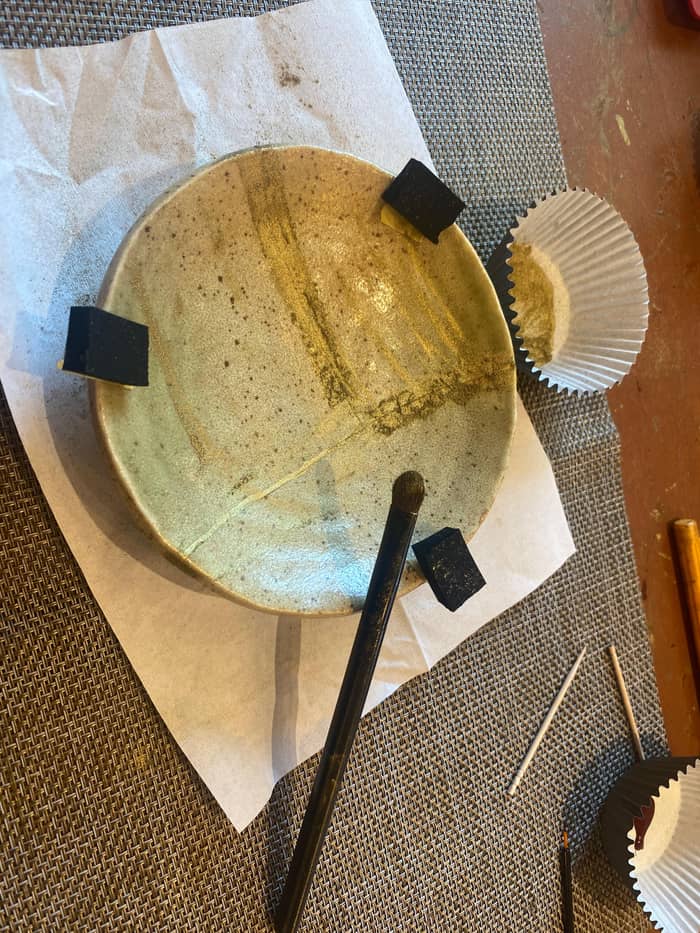
Where it took shape
Muromachi and after
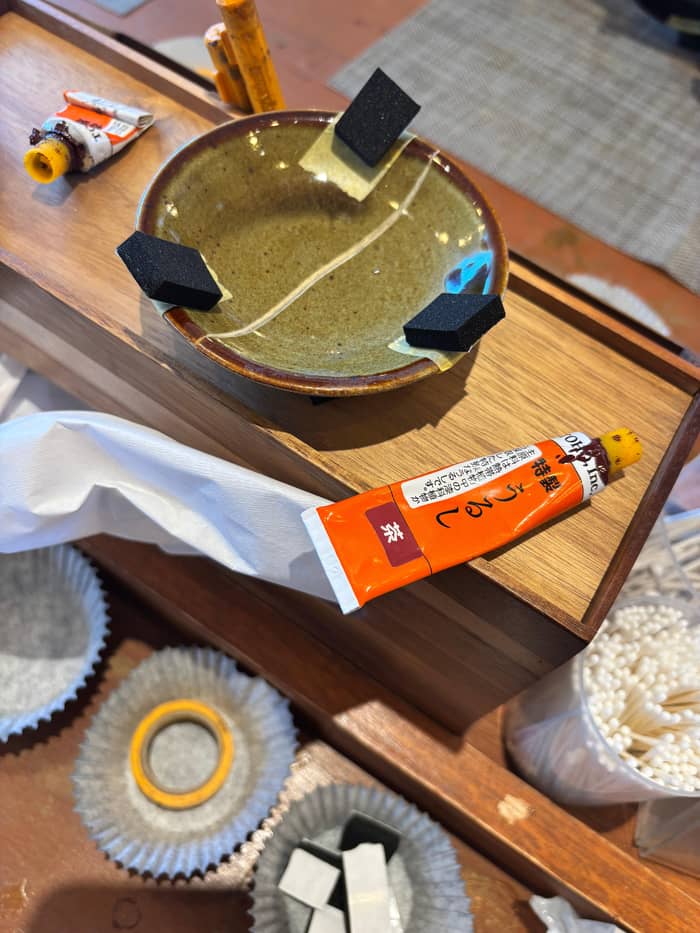
Recent decades
Public and global
By the Edo period the method had a standard form. The Embassy of Japan in Singapore says kintsugi was perfected in the Edo period, when only natural materials were used for the lacquer, such as rice powder and mountain soil.8 That detail matters because it separates the old repair from the modern shortcuts that we compare on our page about traditional and modern kintsugi.
The same source says kintsugi was still limited to repairing tea ceremony items, while ordinary items were mended with lead glass in a technique called yakitsugi.16 In other words, the golden seam was a privilege of the tea room. A household bowl got a plain fix, and a prized tea bowl got a seam worth looking at.
This is also where the craft acquired its long apprenticeship. JNTO says kintsugi remains a refined art form that takes many years of practice to master, and it adds that one 20-year-old tree can yield only about a cup of lacquer before it is cut down, which helps explain why the material was treated with respect.20,21 A short class tastes the craft, it does not replace that training.
Dates in order
Jomon period
Fixing vessels with lacquer goes back to this period.1
Muromachi, 1336-1568
Tea ceremony culture flourishes and the technique starts to be used.2
Late 15th century
A damaged Chinese tea bowl goes to China and returns clamped.3
Edo period
Only natural materials such as rice powder and mountain soil are used.8
The 2000s
A beginner guide helps it spread beyond tea circles.4
March 2024
The Oxford English Dictionary adds the word.5
For centuries the story stays in Japan, and then it breaks out. The Embassy of Japan in Singapore says it was only in the 2000s that kintsugi spread to the general public, thanks to a beginner guide.4 The Oxford English Dictionary records the English word kintsugi as earliest seen in a 2008 issue of Nikkei Weekly, defined as the Japanese art of repairing broken pottery with lacquer dusted with powdered gold, silver or platinum.22
Then came a disaster. Japan Up Close says that after the 2011 Great East Japan Earthquake, in which many objects were destroyed, kintsugi seems to have gained even more popularity.17 That is why so many people today describe the Japanese art of repairing broken pottery with gold as a philosophy of recovery as well as a craft, and why museums and workshops now explain it to visitors.
The word finally entered a major reference work. Nippon.com reports that in March 2024 kintsugi was added to the Oxford English Dictionary, a sign of its growing international presence.5 Cambridge Dictionary defines it as the Japanese art of repairing broken pottery in a way that does not hide the break, using gold or silver in the cracks.23 Few craft terms make that leap.
Video
BBC Global on YouTube · Video data is requested only when you tap play.
One theory of the origin of kintsugi is that it emerged when Japanese shogun Ashikaga Yoshimasa sent a damaged Chinese tea bowl back to China for repair in the late 15th century.
Checklist
Part of the appeal is an old attitude toward things. Japan Up Close notes that kintsugi, as a philosophy, sees breakage and mending as part of an object's history rather than something to disguise.18 JNTO links the technique to sustainability, calling kintsugi a traditional sustainable art form that suits a modern need to manage resources better.24
Japan's Ministry of the Environment points to a related idea. It says Japan was famous for a society based on the Mottainai spirit, the spirit of avoiding being wasteful in life, particularly in the Edo period.25 Mending a bowl in gold is not the same as reducing waste, but the two ideas sit comfortably together, and many visitors arrive at a workshop with that connection already in mind.
The history also explains the class itself. A workshop compresses a craft that was once reserved for tea masters into an afternoon, and it works because the story gives the broken piece a meaning. Our Asakusa class, listed as a 1-hour workshop with real urushi lacquer and gold powder, is built on that tradition. If you want to see mended pieces in Tokyo museums rather than make one, our museums page maps the options.
FAQ
Japan Up Close calls the shogun story only one theory of the origin.3
It started to be used in the Muromachi period, from 1336 to 1568, with the tea ceremony.2
It was used for ordinary items while kintsugi stayed with tea ceremony pieces.16
The Oxford English Dictionary added it that month, per Nippon.com.5
Sources
Continue reading
Questions about the session? Someone on the team answers right here.