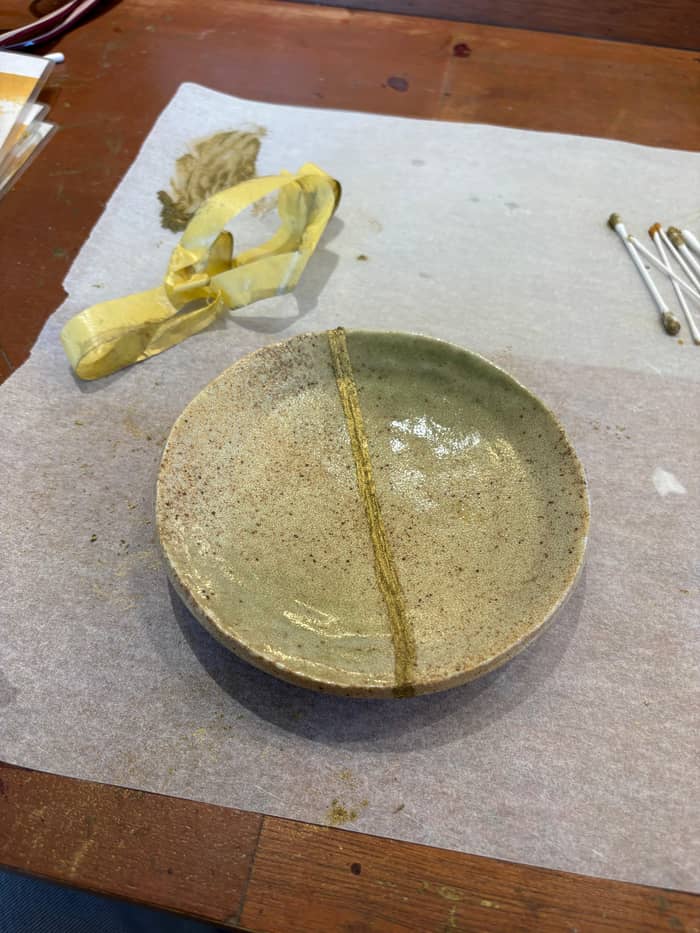
Take it home
A finished piece
Studio shelves in Asakusa
- WhereStudio, in person
- WaitNone
- RiskSells out quickly
Explore the stops
Fast answer
Where to buy kintsugi in Tokyo: the Tsugu Tsugu studios in Asakusa and Ebisu sell finished pieces, and its kits hold from 0.1 g to 0.5 g of gold powder.
Shopping essentials
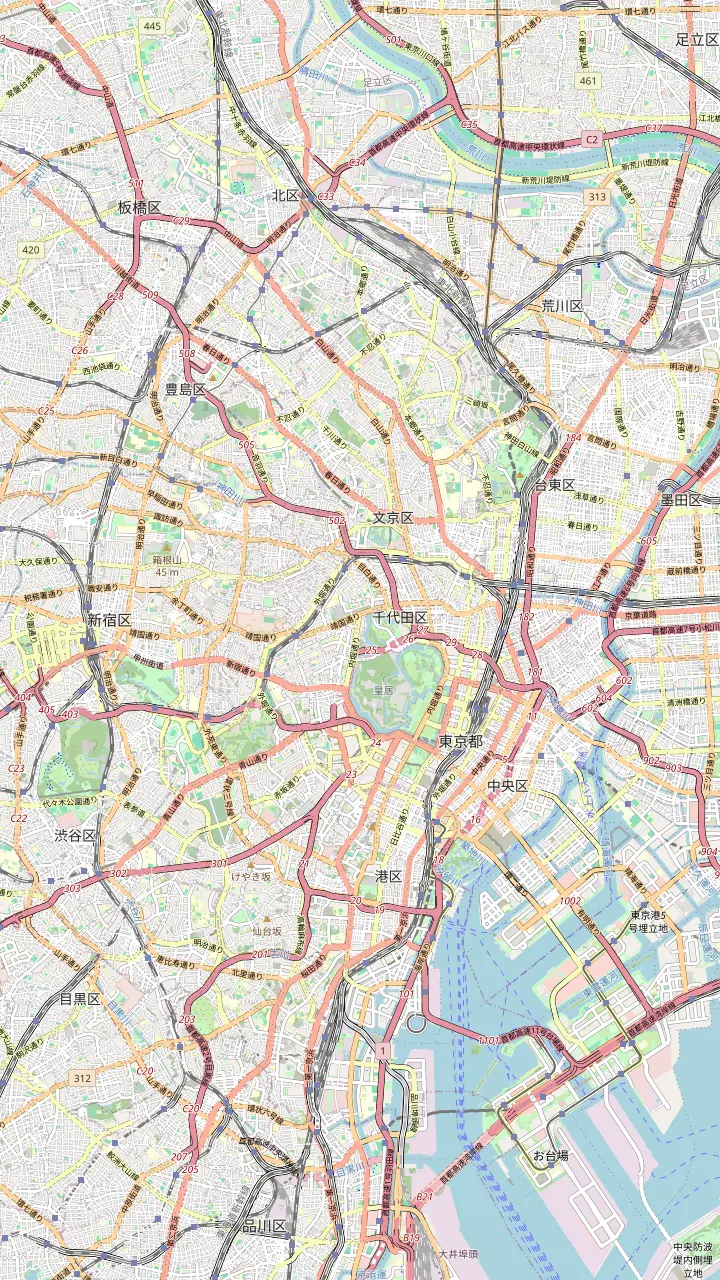
Map of 9 stops
Choose a route, then tap a marker or stop for a note and Google Maps.
Its collection records include a Ninsei water jar mended in kintsugi after the 1923 earthquake and a Joseon tea bowl with repairs in gold lacquer.
Google MapsOpen 10 am to 5 pm, with the garden and cafe on the same hours, and closed on Mondays except when a national holiday moves the closing to Tuesday.
Google Maps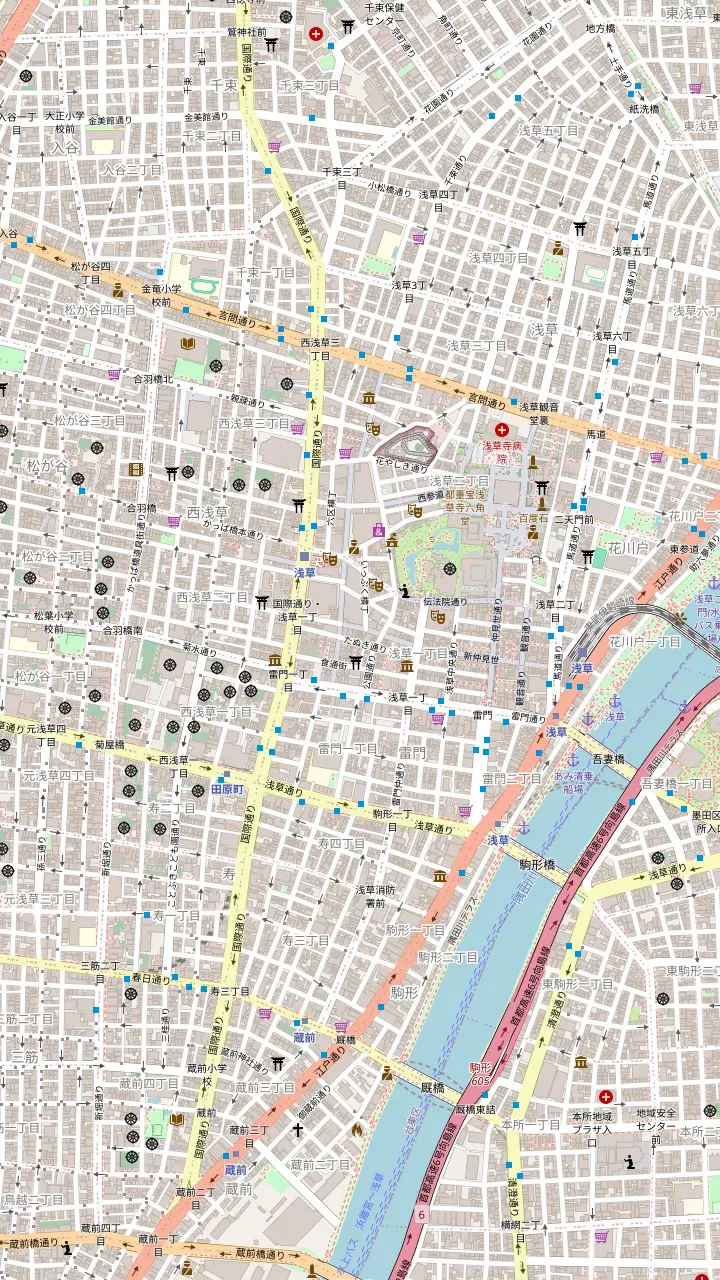
The Tsugu Tsugu studio in Asakusa has its address on Kaminarimon, at 1-1-2, near the gate.
Google MapsOur listing places the kintsugi workshop minutes from this temple, on the 10th floor of a building with a sign at the entrance.
Google MapsThe Tsugu Tsugu studio is 3 to 4 minutes on foot from this station.
Google MapsKappabashi is 5 minutes on foot from this stop on the Ginza Line.
Google MapsThe kitchen street has about 160 shops, with racks of colorful, well-priced Japanese ceramics.
Google Maps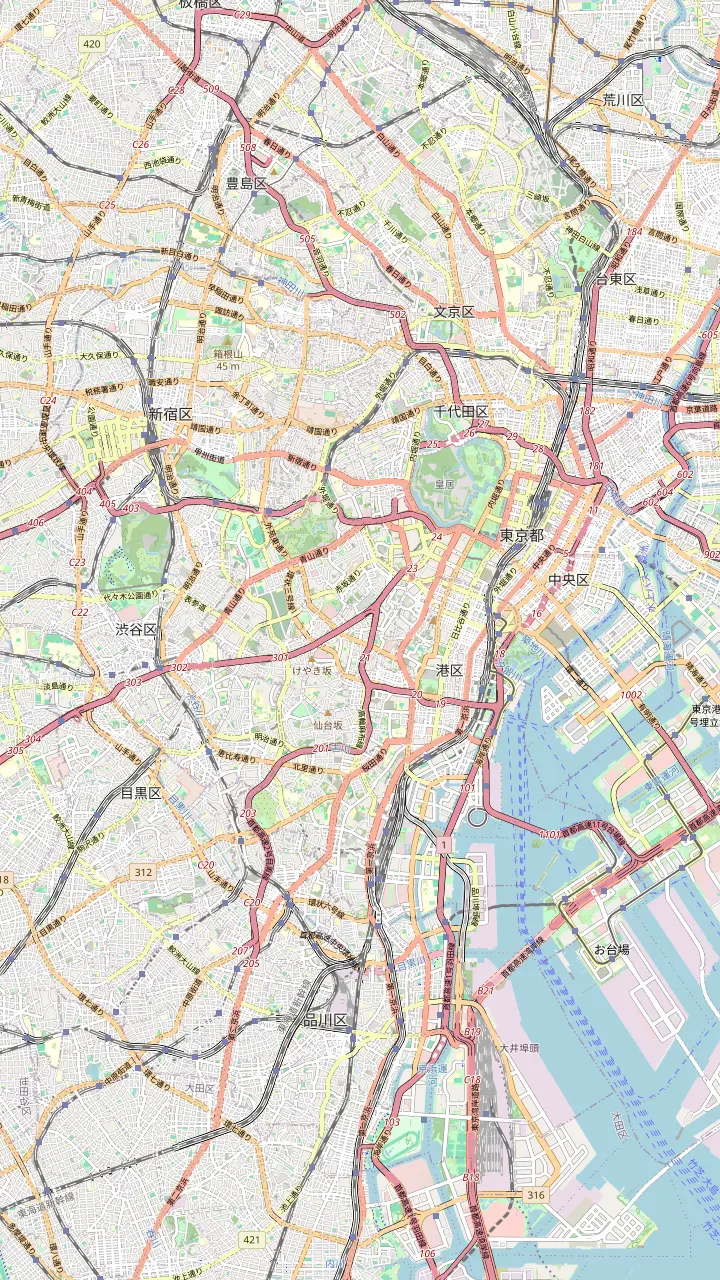
The Oedo Antique Market has free admission, runs 9:00 to 16:00, closes in rain and counts 250 dealers.
Google MapsThe Tsugu Tsugu Ebisu studio is 12 minutes on foot from here.
Google MapsMap © OpenStreetMap contributors
Tokyo sells kintsugi in three forms: mended pieces, kits to do it at home and repairs of your own broken ware. Here is where each is on offer, what the labels mean and how to carry it home.
Editorial team, kintsugitokyo.com · Updated November 6, 2026 · Takes 6 min
Basics
Start by deciding which purchase you want. Some travelers want a finished mended piece to put on a shelf. Others want a kit, so that they can repair a favorite cup themselves at home. A third group wants a professional to mend something that already broke, a repair that returns to the owner later. Tokyo offers all three, but through different doors, and the same word kintsugi hides very different products.
The key difference is material. In the traditional version, Tsugu Tsugu says, real kintsugi uses urushi lacquer and genuine gold powder, unlike imitations that use synthetic glue and fake gold.7 That is the operator's own claim, and it is worth treating as a seller's view, but it matches how museums and tourism bodies describe the method, with lacquer and a gold, silver or platinum finish.8
Keep your goals realistic as well. A traditional piece needs weeks of curing, a repair needs months, and a kit needs patience at home. If you are in Tokyo for a few days, the realistic options are a finished piece, a kit for later or a class that you take part in yourself. Our class comparison page covers that last choice in detail.
Where to look
| Place | What you can buy | Good to know |
|---|---|---|
| Asakusa studio | Restored vessels, kits | 3 to 4 min from Asakusa Station |
| Ebisu studio | Restored vessels, kits | 12 min from Ebisu Station |
| Studio online shop | Smaller vessels, kits | Larger pieces not sold online |
| Oedo Antique Market | Old pots to mend | Free, 9:00 to 16:00, no rain |
| Kappabashi | Plain bowls, cups | About 160 shops |
Walking times and shop counts come from the operator pages, the street association and GO TOKYO; the market closes in rain.12,13,1,5,16
The clearest example of a kintsugi shop in Tokyo that we could verify is the operator Tsugu Tsugu, which opened its first studio in Ebisu in February 2021 and a second in Asakusa in May 2022.11 Its Asakusa studio is at 1-1-2 Kaminarimon, 3 to 4 minutes on foot from Asakusa Station and 3 minutes from Tawaramachi Station.12 The Ebisu studio is at 2-21-2 Ebisu, 12 minutes on foot from Ebisu Station.13
The operator says larger restored vessels are not available online because of the risk of damage in international shipping, and that they are sold exclusively at its studios.1 It adds that vessels often sell out quickly and that customers who visit in person get priority.14 The practical lesson is to go in person and early in your trip, and to decide quickly when a piece speaks to you.
Smaller pieces can be bought online, and a visitor to Asakusa can combine the studio with the Kappabashi kitchen street nearby. Do not expect a bargain: each piece is a hand-mended vessel, and the ones with real gold take weeks of work. We do not quote prices because the studio does not publish them in the pages we read, and a guess would be worse than a gap.
People who ask where to buy a kintsugi kit in Tokyo usually want a box that holds the lacquer, the powder and the tools. The Tsugu Tsugu range shows how kits differ. A Starter kit contains 0.1 g of 23kt gold powder, a Traditional kit 0.3 g of 23kt gold and 0.5 g of silver powder, and a Gold Only kit 0.5 g of 23 kt gold powder, all sold as genuine urushi kits.2,15,3
The operator says that while some kits use synthetic materials, its own use only natural ones.20 It also warns that proper drying requires the right temperature, humidity and patience, which can take several days to a week or more, and that touching raw urushi can cause a rash similar to poison ivy.17 A kit is therefore a project, not a souvenir that you can use at the next dinner.
Kits also appear in the cost of the studio's regular classes. The material fee for a Tsugu Kit runs from 9,800 to 22,000 JPY and depends on the gold or silver type, and it is not included in the class price.21 Compare that with the price of a one-hour group workshop before you decide, since a class gives you a finished plate and a kit gives you a long weekend of work.
What to buy
Start with how long you are in town.
If I leave very soon
A finished piece
Larger pieces are sold at the studios, and kits need days to dry.1,17
If I want to repair my own cup later
A kit
If I have an heirloom to mend
A studio repair
Repairs usually take at least three to four months.4
If I want to learn the steps
A class
Our listing says real urushi lacquer and gold powder.
If I want a cheap pot to practice on
Kappabashi
Three routes
Take it home
Studio shelves in Asakusa
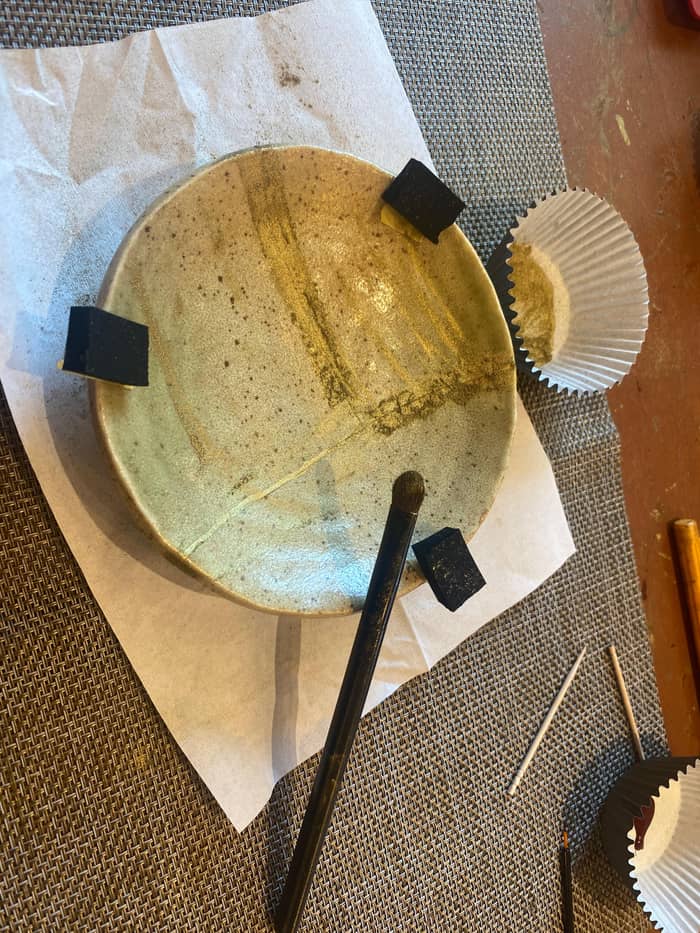
Do it later
Urushi and gold powder
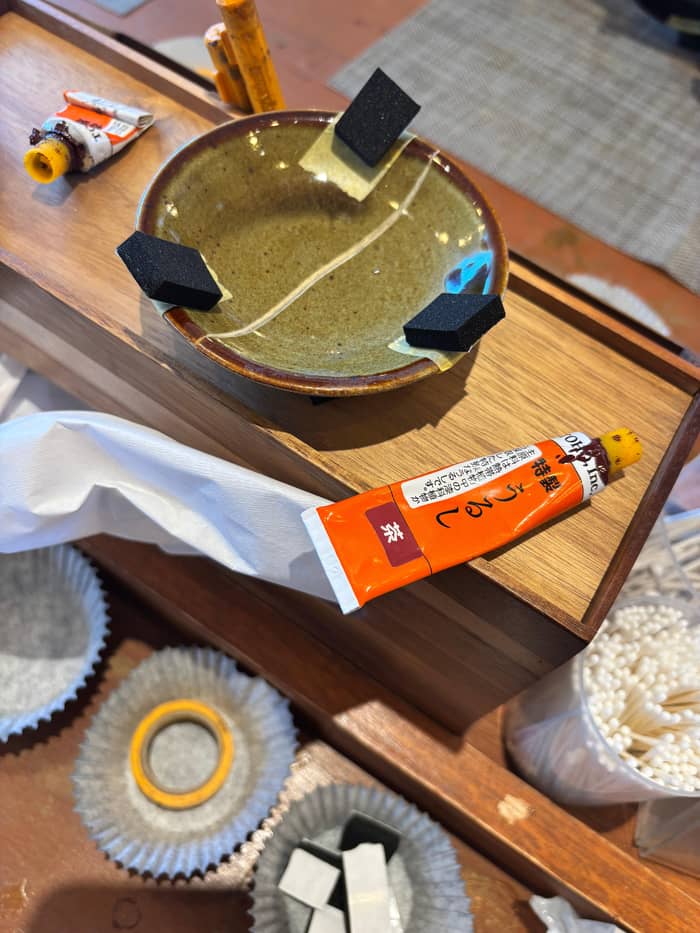
Learn by doing
Our 1-hour workshop
Labels matter more than names. One Tokyo studio explains that its traditional finish uses 23K gold powder and that a brass finish is not certified as food safe.9 Its epoxy workshop, by contrast, uses a brass-colored finish and is not meant for repairing tableware for food use.27,28 If a piece will touch food, ask what the powder and the binder are.
Price helps a little. LACMA conservators note that brass powder costs far less than gold powder, which is why they used brass in a practice exercise.19 A very cheap kit with a bright metallic finish is therefore likely to use a substitute, and a mid-priced one may use gold in tiny amounts. The gram weights in a kit description are the quickest sign of how much real gold you are paying for.
Ask about the lacquer, too. Urushi is the natural lacquer that JNTO says is made from the sap of a tree, and that one 20-year-old tree yields only about a cup of lacquer before it is cut down.29,30 That scarcity is part of why real urushi costs more than a synthetic binder. Our page on traditional against modern kintsugi lists the questions to put to any seller before you pay.
Try before you buy
Type your party size and see each class total.
Compare 3 side by side
Type your party size and see each class total.
≈
View≈
View≈
ViewFigures are GetYourGuide from-prices, translated at the ECB reference rate. The booking step shows what you pay exactly.
A shopping path
Visit
Larger pieces are sold only at the studios.1
Decide
Ask
A brass finish is not certified as food safe.9
Pay
From November 1, 2026 the refund comes at departure.6
Fly
Carry-on liquids stay at 100 ml or less.10
You can also hunt for the broken piece itself. The Oedo Antique Market at Tokyo International Forum in Yurakucho is held on set dates, among them November 7 and 23 and December 12 and 20, 2026, and is canceled in August for the heat.31 Admission is free, it runs from 9:00 to 16:00, closes in rain and counts 250 dealers.5
Kappabashi, the kitchen street near Asakusa, is a 5-minute walk from Tawaramachi, a stop on the Ginza Line of the Tokyo Metro.26 The kitchenware association counts over 170 shops along 800 meters, and GO TOKYO notes racks of colorful, well-priced Japanese ceramics among them.32,18 A plain bowl from there is a sensible thing to practice on.
A sensible shopping loop pairs a studio with a market: see mended pieces in Asakusa, buy a plain bowl at Kappabashi to practice on, and look for old pieces at the antique market on its next date. All three places are on the map above. If you want a broader guide to ceramics, our page on Japanese pottery shopping covers the main wares and the shops.
Video
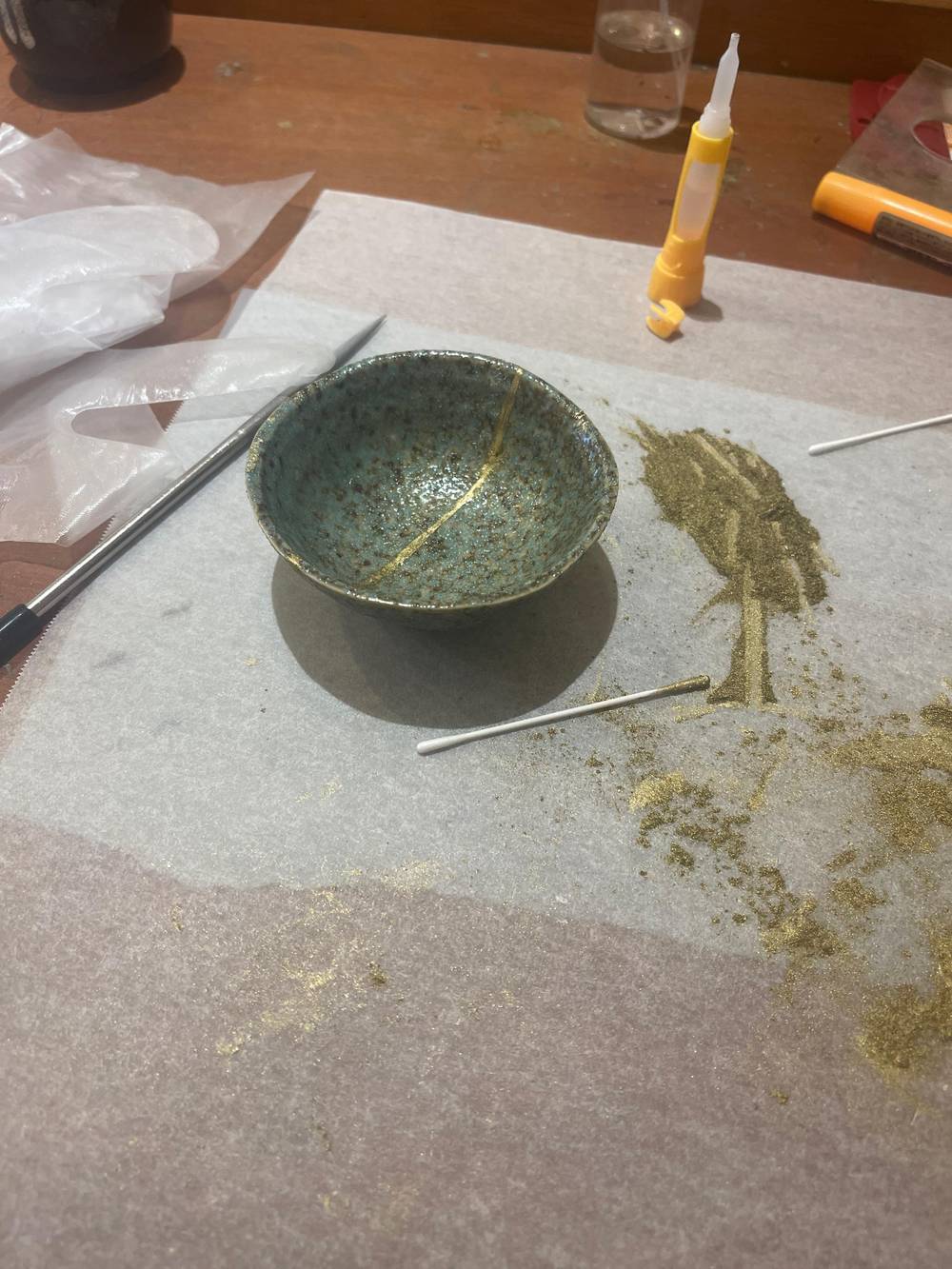
MUSUBI KILN on YouTube · Video data is requested only when you tap play.
Usually gold powder would be used, but gold powder is much more expensive than brass powder and not necessary for this practice exercise.
Checklist
Tourists buying at tax-free shops should know that the rules changed on November 1, 2026. Japan Customs explains that anything bought from November 1, 2026 falls under a refund scheme: you pay the full price and the consumption tax comes back once customs confirms the goods are leaving Japan.6 Purchases of 5,000 yen or more, tax excluded, per store per day qualify.33
You then have to complete the inspection. Within 90 days of purchase you present your passport at a tax-free terminal at the airport or seaport, and that step completes the procedure.34 Keep the receipts, pack the item where you can reach it at the airport, and check with the shop whether a repaired vessel counts as an eligible item.
Flying with lacquer needs a small plan. Narita Airport says carry-on liquids must be in containers of 100 ml or less, inside one transparent resealable bag of up to 1 liter, so a kit with liquid lacquer should go in checked baggage.10 The same operator notes that a piece made in its workshop can go home the same day in a drying box, so ask how to pack it.35
FAQ
It is at 1-1-2 Kaminarimon, 3 to 4 minutes from Asakusa Station.12
Traditional repairs usually take at least three to four months, collected in person.4
From November 1, 2026 you pay in full and claim the tax at departure.6
Carry-on liquids must be in containers of 100 ml or less, so check bags.10
Sources
Continue reading
Questions about the session? Someone on the team answers right here.